


The Best 36 Inch Gas Range in 2026: What the Specs Actually Tell You
You priced a professional range, then you priced a basic one, and the gap was several thousand dollars for two appliances that both say 36 inches on the spec sheet and both burn gas.
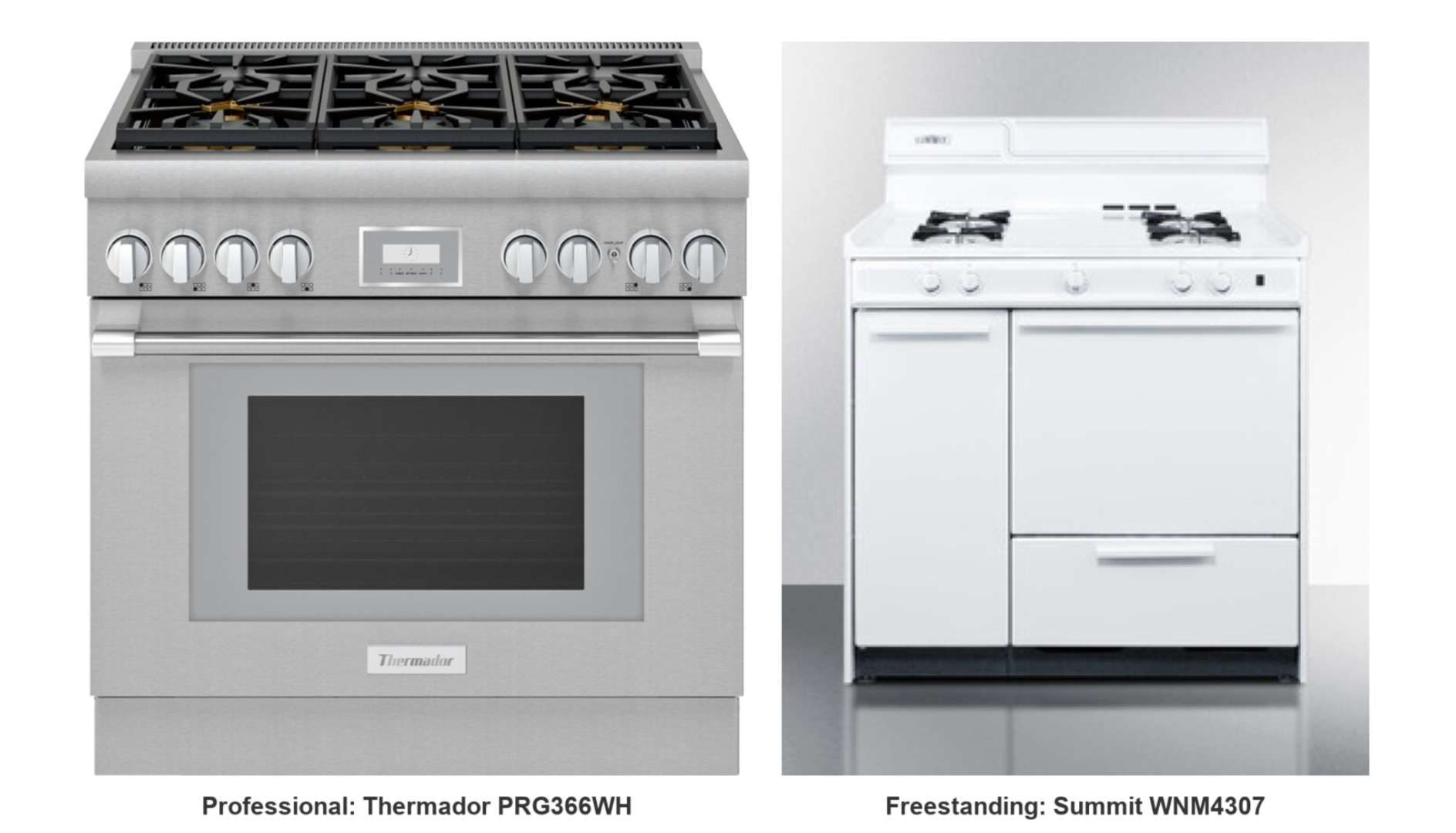

That gap is the real question. Not which range is best in the abstract, but what the extra money buys and whether you personally will ever use it.
This guide compares 36 inch gas ranges on published numbers you can check yourself. We are Mr Appliance Sales, an appliance retailer, and every model discussed in detail below is one we stock, so we would rather say that up front than have you wonder. Our own 36 inch range lineup spans from $938.75 to $7,749, which is a useful spread for answering exactly this question. Every number below is either a manufacturer-published spec or an attributed third party figure. Where the expensive ranges genuinely beat the cheap ones, we say so just as plainly as we say the reverse.
Professional and freestanding 36 inch gas ranges side by side showing countertop overlap and backguard height
What Consumer Reports Publishes, and What Sits Behind the Paywall
Plenty of people land on this topic by searching for a 36 inch gas range Consumer Reports verdict. Here is what you will and will not find there.
Consumer Reports does lab test ranges, and their range testing is among the more rigorous in the category. What they do not do is publish the results for free. Model level scores, brand reliability rankings, and their testing procedures sit behind a member paywall, which is why the free pages never quite answer the 36 inch question.
We cannot reproduce those ratings here, and you should be suspicious of any retailer that claims to. Nobody selling you a range has a licence to republish another organisation's test scores, and a page that implies otherwise is telling you something about its own trustworthiness.
One substantive thing does sit outside the paywall, and it is useful. Kenneth Sutton, the CR engineer who leads their range testing, is quoted on their pro-style range page saying "We see conventional ranges under $1,000 near the very top of our performance ratings" and that "many pro-style ranges at five times the cost just don't cook all that well" (Consumer Reports, 2026). That comes from an organisation with nothing to sell you. It carries more weight than any spec sheet.
That first quote is worth sitting with, because the cheapest range on this page lands under $1,000. It does not mean the cheap range wins. It means the assumption that price tracks cooking performance is not one Consumer Reports' own testing supports.
So this guide falls back on what anyone can check independently: published specifications, with the prices attached.
The Four Specs That Decide a 36 Inch Gas Range
Strip away the finishes and the smart features and four numbers decide how a 36 inch gas range behaves day to day. Nearly every meaningful difference between a nine hundred dollar range and an eight thousand dollar one shows up in one of them.
Total and Peak BTU Output
Two different numbers get called BTU and they answer different questions.
Total cooktop output is every burner added together, and it mostly tells you how the range performs when the whole surface is running during a holiday dinner. Peak output is the single hottest burner, and that is the number that boils a stockpot quickly or gets a cast iron pan hot enough to sear properly.
Here is the part that surprises people: peak burner output does not climb steadily with price. Among the professional models Yale Appliance ranks, the highest peak burner is BlueStar's 25,000 BTU PrimaNova on a range listed at $16,085 (Yale Appliance, July 2025). Thermador's Pro Harmony, which costs less than half that, tops out at 18,000 BTU. Doubling the price does not double the heat, and often does not raise it at all.
Where the spread is genuinely wide is at the bottom of the lineup. A basic four burner 36 inch range runs 9,000 BTU per burner, so the difference between that and a professional Star Burner is real. It just is not a difference you keep buying as you climb past the mid tier.
The Simmer Floor
Almost nobody compares this spec. It separates the price tiers far more reliably than peak output does.
A burner's simmer floor is its lowest stable setting, and it decides whether you can hold a pan sauce just below a bubble or melt chocolate without reaching for a diffuser. Turn a burner too low and it either goes out or cycles, and neither is any good when you are reducing something for forty minutes.
The gap here is real. Thermador's ExtraLow burners drop to 375 BTU and hold around 100 degrees Fahrenheit, while a standard 9,000 BTU open burner on a basic range has no dedicated low setting at all beyond turning the knob down and hoping. If you cook the kind of food that lives at the low end of the dial, this is where the premium money goes.
Oven Capacity
Capacity is usually the real reason people move up from 30 inches to 36. It gets a fraction of the attention burner specs do, and at this width it is the single most misunderstood spec on the sheet.
Do not assume a 36 inch range means a 36 inch oven cavity. Budget 36 inch ranges often devote part of that width to a storage cabinet or a separate broiler compartment, which leaves an oven around 2.9 cubic feet, smaller than many 30 inch ranges. Professional models at the same width run closer to 5 cubic feet.
That difference decides whether a full size sheet pan fits turned sideways, whether a large turkey has clearance for air to move around it, and whether you can run two racks at once without the top one shielding the bottom one. Check the cubic feet, not the width. It is the spec most likely to disappoint you after delivery.
Build, Grates and Warranty
Cast iron grates hold heat, sit heavy enough that a wok does not shift, and survive being scrubbed. Enamel or lighter grates telegraph every knock and warp over time, so grate material is a reasonable proxy for how the rest of the range is built.
Warranty terms are the other checkable proxy, because they are the manufacturer telling you how confident it is. One year of parts and labour is the budget standard. Two years signals more. Read what is actually covered rather than the headline number, since parts coverage and labour coverage often run on very different clocks.
Slide In vs Freestanding at 36 Inches
This distinction causes more expensive mistakes than anything else in the category. Get it right before you shortlist a single model.
A freestanding range has finished sides and usually a backguard behind the cooktop. It drops into a 36 inch opening with the most tolerance for cabinetry that is not perfectly square, which is why it dominates the selection at this width. A slide-in range sits flush instead, overlapping the countertop edge on both sides for a built-in look, and it needs a precise cutout with finished cabinet sides on either side.
Here is the trap. A freestanding range's backguard adds height above the cooktop surface, so moving from a slide-in cutout to a freestanding unit is the difficult direction and can create clearance problems with upper cabinets or a hood. Going the other way is usually easier. If you are replacing a slide-in, check the height to the bottom of your hood before you fall in love with a freestanding model.
Professional ranges muddy this a little. Thermador's Pro Harmony is a freestanding range built to a 24 inch depth specifically so it sits flush with standard cabinetry, which gets you the built-in look without a true slide-in cutout. That is a third category worth knowing exists.
Before you shortlist anything, measure three things: the opening width, the depth from the back wall to the counter edge, and the height from the floor to the bottom of your hood. Those three numbers eliminate more models than any spec on this page.
Three measurements for a 36 inch gas range install: opening width, wall to counter depth, floor to hood height
Where Your Money Goes as the Price Climbs
Nobody publishes this comparison. That is strange, because it is the only one that answers the question people arrived with. Here is our entire 36 inch range lineup, laid out on the specs that matter.
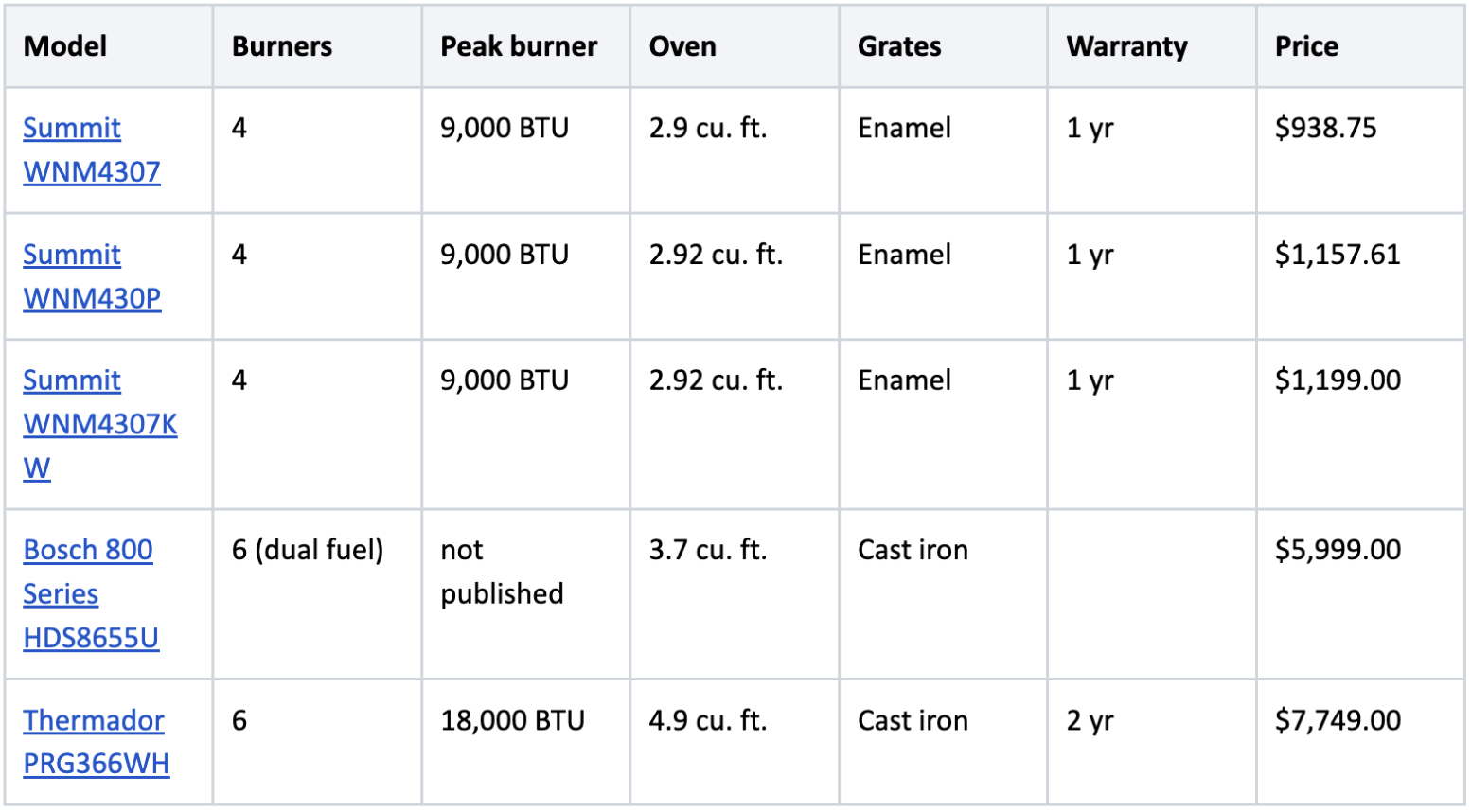
All figures come from the manufacturer specifications published on our own product pages, checked on 27 July 2026. Prices in this category move, so treat them as a snapshot rather than a quote.
Read that table across rather than down and the pattern is clear. Peak burner output roughly doubles from the Summit to the Thermador, but the price goes up more than eight times. The heat is not what you are buying.
What you are buying, in order of how much it will change your cooking: oven capacity, which climbs from 2.9 to 4.9 cubic feet. Simmer control, which goes from nonexistent to a burner that holds 100 degrees Fahrenheit. Grate material, enamel to cast iron. Warranty, one year to two. Then service network depth, meaning how fast an authorised technician reaches you and how long parts stay available, and field history, which Thermador and Bosch have accumulated over decades.
None of that shows up in a peak BTU number. Which is precisely why choosing on peak BTU alone gets people into trouble.
Key insight: Peak burner output does not track price in the 36 inch gas range category. Across our lineup the peak burner doubles while the price rises more than eightfold. What the extra money reliably buys is oven capacity, simmer precision, cast iron build and warranty depth, not raw heat.
The Budget Picks: Summit 36 Inch Gas Ranges
Three of our 36 inch ranges are Summit models in white porcelain, and they are close enough on paper that the differences between them are easy to miss.
All three share the same core. Four open burners at 9,000 BTU each for 36,000 BTU total, an oven of roughly 2.9 cubic feet with two adjustable racks, built-in enamel grates, porcelain and steel construction, a broiler compartment, a storage cabinet, an anti-tip bracket in the box, and one year of parts and labour. All three measure 36 inches wide, 44 inches high and 24 inches deep, all three are freestanding, and all three ship configured for natural gas with a propane conversion kit available separately. All three are made in the USA.
The differences come down to ignition and convenience.
The Summit WNM4307 at $938.75 uses electronic spark ignition and comes with a pre-installed 115V three-prong cord, so it needs an outlet behind it. It is the cheapest way into a 36 inch gas range we sell.
The Summit WNM430P at $1,157.61 swaps to battery start ignition. That matters if there is no outlet where the range goes, or if you want the burners to light during a power cut. You are paying roughly two hundred dollars for independence from the wall.
The Summit WNM4307KW at $1,199.00 returns to spark ignition and adds an oven window and interior light, with the same 19 by 19 by 14 inch oven cavity. If you check on food without opening the door, that is the one.
Be clear-eyed about what these are. A 2.9 cubic foot oven is small for the footprint, the enamel grates are not cast iron, and 9,000 BTU is a long way from a searing burner. What you get is a genuinely wide cooktop with four well-spaced burners, a US-made porcelain body, and a price that leaves money in the budget for the rest of the kitchen.
Summit 36 inch freestanding gas range in white porcelain with four open burners and storage cabinet
The Middle: Bosch 800 Series HDS8655U
The Bosch 800 Series HDS8655U at $5,999.00 is the industrial-styled step up, with six sealed burners under continuous cast iron grates, a 3.7 cubic foot convection oven with eight cooking modes, telescopic racks, a soft-close door and pedestal feet. It measures 36 inches wide by 36 high by roughly 24.9 deep and weighs 218 pounds.
One thing to be very clear about before you order, because it is the most common mistake made on this model. The HDS8655U is dual fuel, not pure gas. The cooktop burns gas; the oven is electric. That means it needs a 240V electrical circuit as well as a gas line, and if you are shopping specifically for an all-gas range because you prefer a gas oven or because your kitchen has no heavy electrical service, this is not the model for you. Look at the Thermador below or the Summits above instead.
For a lot of people the electric oven is the reason to buy it rather than a reason to avoid it, since electric ovens hold temperature more steadily and produce drier heat for baking. Just make sure it is a choice you made rather than one you discovered on delivery day.
Our product page does not currently publish per-burner BTU figures for this model, so if a specific peak or simmer number decides your purchase, call us and we will read it off the manufacturer sheet rather than guess at it here.
The Top of the Line: Thermador Pro Harmony PRG366WH
The Thermador PRG366WH at $7,749.00 is the all-gas professional option, and it is the only range in our 36 inch lineup that is both pure gas and genuinely pro-grade.
Six Star Burners deliver 120,000 BTU total, with the top burner reaching 18,000 BTU. Two of the six are ExtraLow burners that cycle down to 375 BTU and hold around 100 degrees Fahrenheit, which is the spec that actually separates this range from everything else on the page. The oven is 4.9 cubic feet with roast, bake, convection bake and broil, the grates are cast iron with rubber feet, the panel is a TFT touchscreen, the range is Home Connect WiFi enabled, and the warranty is two years of parts and labour. It stands 35 and 7/8 inches high by 35 and 15/16 wide at a 24 and 3/4 inch depth, built to sit flush with standard cabinetry.
Nine hundred dollars against seven thousand seven hundred is not a close call on paper. What you are buying at the top is the low end of the dial, an oven nearly 70 percent larger, and a cooktop built to be cooked on hard for twenty years.
Where the Expensive Ranges Still Win
A 375 BTU ExtraLow burner is not a 9,000 BTU open burner turned down. If you reduce sauces regularly, temper chocolate, or hold a custard just under the point where it splits, you will feel that difference every time you cook, and no amount of peak BTU compensates for it.
Oven capacity is the other one people underestimate. Going from 2.9 to 4.9 cubic feet is not a marginal upgrade, it is the difference between a sheet pan fitting and not fitting. If you bake, or if the reason you are buying 36 inches is holiday cooking, that number should probably decide your purchase before anything else does.
Premium brands also carry deeper authorised service networks. When a Thermador needs a part in year eight, there is an established channel for getting it. That infrastructure is genuinely part of what the price covers, and it matters more the longer you plan to keep the appliance.
One more thing, said plainly. No independent laboratory publishes long run reliability data on the budget tier that we could point you to. Nobody can tell you how a budget range will be performing in year twelve, and anyone who claims otherwise is guessing. Premium brands have decades of field history behind them. Budget brands have specifications and a shorter track record.
If you cook at a level where the low end of the dial matters, or you intend to keep this range for fifteen years, buy the premium tier. That advice costs us the easy sale and it is still the right advice.
Questions Worth Asking Before You Buy
Most range regret traces back to something nobody asked at the point of sale. These five questions prevent most of it.
- Is the range configured for natural gas or liquid propane, and is a conversion kit included if you need one?
- Is it all-gas or dual fuel, and does the install location have the electrical service the model requires?
- Does the opening width, the wall to counter depth, and the floor to hood height all clear the model's published dimensions?
- Is the oven capacity in cubic feet large enough for what you actually cook, regardless of the 36 inch width?
- Who performs warranty service in your area, and what is their typical response time?
That last question deserves far more weight than it usually gets. A range with excellent specs and no local technician is a worse purchase than a modest range backed by someone who picks up the phone. Ask us these questions directly about anything on our floor and you will get a straight answer, including who handles warranty work on the brands we carry.
Ready to Compare 36 Inch Gas Ranges in Person
Specs get you to a shortlist. They do not tell you how a door feels when it swings, how much a grate weighs when you lift it, or whether the knobs turn with the resistance you want.
Our freestanding range collection and professional range collection carry current stock and live pricing on every model above. If you are shopping the budget end, the Summit WNM4307 is the sensible starting point. If the low end of the dial or a full size sheet pan matters to you, start at the Thermador PRG366WH instead. Bring your three measurements and we will tell you what actually fits, including the times the answer is that you should spend more than you planned.